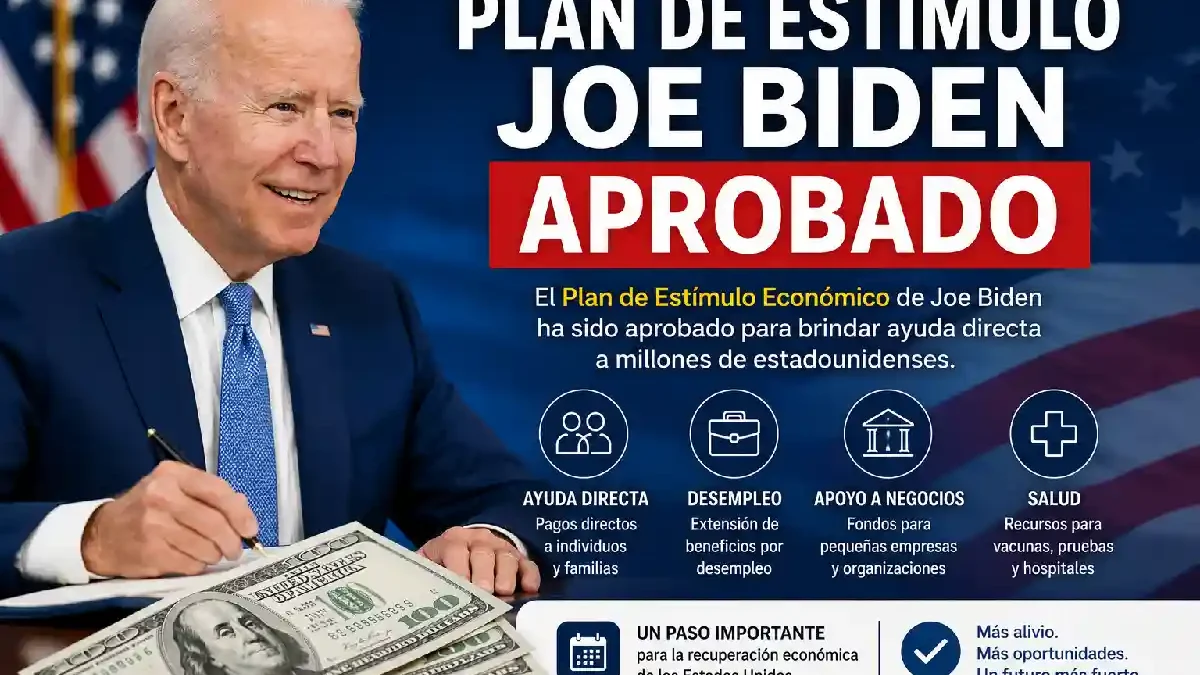

This keyword refers to an article on the Finanzas Domésticas website published in March 2021 on the subject of the approval of the economic stimulus plan by President Joe Biden. In the article, the American Rescue Plan was discussed – the estimated bill with a cost of $1.9 trillion, including payments up to $1,400 per person, as well as aid related to unemployment insurance, education, assistance to states, housing, health care, and family.
This act served as one of the most significant economic measures concerning the situation formed due to the COVID-19 pandemic and helped the population receive the needed aid while the whole country faced it.
Nevertheless, it is required to specify the context here. American Rescue Plan was the 2021 act and not the current stimulus bill that has not yet been approved. Third Economic Impact Payments were provided in accordance with the act, and therefore, the IRS provides historical information about them and the 2021 Recovery Rebate Credit.
Table of Contents
What Was the American Rescue Plan?
American Rescue Plan Act of 2021 was a broad economic relief package adopted by the government in response to the COVID-19 pandemic.
In contrast to stimulus checks, it supported a variety of areas of the economy, including:
- Economic Impact Payments;
- Unemployment assistance;
- Child-related tax benefits;
- State and local governments;
- Schools and educational institutions;
- Housing assistance;
- Public health programs;
- Small businesses;
- Vaccine distribution.
The purpose of the Act was to assist both households and institutions during the period of economic recovery following the pandemic.
According to the Finanzas Domésticas news, the House of Representatives passed the final version of the American Rescue Plan on March 10, 2021, so it is to be signed by President Biden.
When Was the Biden Stimulus Plan Approved?
The timing of the adoption of the bill is important for the understanding of the story.
As mentioned above, the House passed the final version of the American Rescue Plan on March 10, 2021, and President Biden signed the bill on March 11, 2021. Thus, the process of sending the Economic Impact Payments to those who qualified started almost immediately.
It should be noted that it happened just two months after President Biden took office and millions of Americans continued suffering from unemployment, reduction of their incomes, business closures, and other effects of the pandemic.
Why Was Another Stimulus Package Needed?
Two previous stimulus packages provided direct payments for Americans in response to the COVID-19 pandemic.
The first and the second Economic Impact Payments were related to 2020 legislation, which means that each eligible individual received $1,200 for the first time and $600 for the second time, according to IRS data.
Therefore, another stimulus was needed because the economic recovery process was not completed yet.
How Much Was the Third Stimulus Payment?
Eligible people would get the maximum of $1,400 in the third Economic Impact Payment.
The Internal Revenue Service states that the maximum 2021 Recovery Rebate Credit per eligible person, including any qualifying dependents, would be $1,400. As a result, eligible people married but filing jointly with two qualifying dependents would get a maximum credit of $5,600.
It is due to the fact that the amount of money would be dependent on eligibility and income.
Therefore, the economic impact payment was not just a $1,400 economic impact payment for all Americans.
Eligibility for the $1,400 Payment
Different aspects played a role in determining the eligibility criteria for this economic payment. These criteria included tax filing status, income, dependency status, requirement for a Social Security Number, etc.
As stated by the Internal Revenue Service, eligible individuals are Americans or residents who qualify according to relevant criteria and who are not claimed as a dependent of any other taxpayer.
The income would also matter.
Main income limits were:
| Filing Status | Full-Payment Threshold |
| Single filer | $75,000 |
| Head of household | $112,500 |
| Married filing jointly | $150,000 |
Did Children and Dependents Receive $1,400?

Treatment of dependents improved significantly under the third stimulus payment.
According to the IRS, taxpayers were entitled to up to $1,400 for each of the qualifying dependents. Notably, dependents’ definition and treatment applied for the third stimulus payment based on the rules set for 2021. As a result, this made the payment much larger if a family had some of the qualifying dependents.
As an illustration, a qualifying family was to get the combined payment for the adults of the family and the qualifying dependents.
The federal government utilized available information via the tax system or other sources for the distribution of payments.
The Treasury reports that the first round of payments started soon after the signing of the American Rescue Plan Act. Most recipients got their payments using direct deposit; others – by means of paper checks or prepaid debit cards.
The purpose of the payment distribution procedure was to deliver payments to households rapidly instead of making people apply for the payments.
What If Someone Did Not Receive the Full Payment?
Here comes the role of the Recovery Rebate Credit.
According to the IRS, taxpayers who did not receive the entire third Economic Impact Payment could potentially claim the 2021 Recovery Rebate Credit on their 2021 federal tax return.
It could occur due to different factors.
For instance:
- An increase/decrease in income between tax years;
- Addition of qualifying dependents;
- Got a smaller amount than ultimately allowed;
- The IRS didn’t have sufficient information to provide the full payment.
Thus, the credit was aimed at reconciling the difference between the actual and allowable amounts.
What Is the Child Tax Credit Expansion?
The American Rescue Plan Act did not limit its impact to providing stimulus payments only.
It temporarily expanded the Child Tax Credit for the 2021 tax year. The IRS says that eligible families could receive up to $3,600 for children below six years old and up to $3,000 for children from six to 17 years old, depending on the income level.
Notably, it is different from the $1,400 Economic Impact Payment.
Thus, the Child Tax Credit expansion was one of the most significant family elements of the act.
How Did the Plan Help Unemployed Workers?
Unemployment assistance was another major part of the package.
Many Americans had lost their jobs or seen their working hours cut drastically during the pandemic. Unemployment assistance was a continuation of efforts made to assist workers affected by the crisis during the American Rescue Plan.
It would have been helpful to cover expenses while labor markets recovered.
Unemployment assistance could prove vital to meeting necessary costs for some households as much as a stimulus check.
Support for State and Local Governments
A certain amount of funding was allocated to state, local, territorial, and tribal governments under the American Rescue Plan.
The idea was to help the government cope with ongoing consequences of the pandemic and provide essential services in the face of fiscal pressures.
Government assistance could allow communities to address issues such as:
- Public health
- Economic recovery
- Local services
- Infrastructure needs
- Pandemic costs
Thus, this part of the Act showed that the stimulus package was broader than just the payment to households.
Educational Funding
Another aspect of the stimulus bill was the funds provided to schools and educational institutions.
The pandemic forced many educational institutions to switch to remote or hybrid forms of education, which entailed substantial costs. Federal funding was to help them deal with those issues.
Educational provisions of the act also took into account that the economy could not recover without ensuring educational opportunities to students affected by the pandemic.
Housing and Rental Assistance
Many families found themselves in a difficult housing situation during the pandemic.
People whose income sources had dried up due to losing their job found it hard to pay rent or mortgage. It could lead to evictions or additional financial troubles.
Thus, the American Rescue Plan allocated money to ensure housing stability and rental assistance.
Those provisions worked together with the stimulus checks and unemployment assistance, covering one of the most costly items in many household budgets.
Healthcare and Vaccination Assistance
There were provisions in the American Rescue Plan related to the public-health response to the pandemic as well.
Vaccination had a direct economic aspect since widespread vaccination was supposed to contribute to businesses opening and consumers going back to business as usual.
Funds were to be allocated to cover:
- COVID-19 vaccination
- Testing
- Public health
- Healthcare access
- Pandemic response
How Did Small Businesses Benefit?
Many small businesses were greatly impacted during the COVID-19 pandemic.
While some businesses had to close down temporarily, others suffered huge declines in customers and income.
The American Rescue Plan offered programs that aimed to offer further assistance to small businesses and organizations suffering from the impact of the coronavirus.
It was meant to help those businesses keep their operations running, employ people, and compensate for their losses during the pandemic.
Why Was the Plan Politically Controversial?
Though the plan eventually became a law, it was a source of controversy.
According to Democratic legislators, such a large bill was needed to ensure that there would be no weak economic recovery and provide sufficient help to working people and families.
Meanwhile, Republicans questioned the bill’s total cost, its large size, and the connection of some expenses to the immediate situation connected with the pandemic.
Ultimately, the bill was approved without bipartisan support for the final package.
This political controversy was a reflection of a disagreement on what size of federal spending is appropriate in times of an economic crisis.
What Was the Economic Purpose of the Stimulus?
The general economic purpose of the stimulus package was to promote demand at a time when the country was dealing with the pandemic.
The money that households receive may be spent on:
- food;
- rent;
- bills;
- doctor’s visits and other healthcare services;
- repayment of debts;
- savings; and
- purchases of daily necessities.
When people spend money, businesses receive income, which stimulates the economy.
As such, government spending impacts the economy both directly and indirectly, meaning through businesses and employees.
How Large Was the Impact of the Direct Payments?
The direct-payment program was immense in size.
As the Treasury reported later on, more than 170 million Economic Impact Payments connected with the third round have been issued, and their total cost exceeded $400 billion.
Such scale turned the program into one of the most prominent components of the federal pandemic response.
At the same time, it posed a great administrative challenge as payments had to be delivered to millions of households according to eligibility criteria.
Did Everyone Get $1,400?
No.
In particular, interpreting the phrase “$1,400 stimulus check” might result in the assumption that all taxpayers will be provided with a check in such an amount.
In reality, while the maximum amount of the check was indeed $1,400, some taxpayers would have received less due to the application of income-based phase-outs.
Depending on the number of qualifying dependents, the total amount of the money might differ as well.
Indeed, according to the IRS, “the maximum Recovery Rebate Credit varied based on the number of qualifying individuals and dependents claimed on the tax return.”
Is the $1,400 Stimulus Check Available Today?
One of the key issues about finding https://finanzasdomesticas.com/plan-de-estimulo-joe-biden-aprobado via the current search is this one.
The third Economic Impact $1,400 Payment mentioned in the original post was a part of the 2021 American Rescue Plan.
As such, it should not be interpreted as the issuance of the new federal stimulus check at the moment.
According to the IRS, the corresponding historical mechanism is the Recovery Rebate Credit from 2021 for those who have not received the third payment.
Thus, caution needs to be exercised when reading current social media publications about a new Biden-era $1,400 stimulus check for all.
What Is the 2021 Recovery Rebate Credit?
The 2021 Recovery Rebate Credit was the mechanism used by eligible taxpayers in order to claim their right to an amount that they were supposed to get but did not in the form of the third economic impact payment.
The IRS states that taxpayers who did not receive the full payment amount need to file the 2021 tax return in order to claim the credit.
The credit could either reduce tax liability or be included in the tax refund for the person.
Regarding taxpayers who have already filed their 2021 tax return, there is guidance regarding amended returns.
Lessons for Personal Finance
Lessons from the Biden stimulus package also extend further into financial planning.
Government aid is useful as a temporary measure, but not a source of ongoing income.
Upon receiving unexpected government money, some possible options can be:
- Covering necessities.
- Emergency fund building.
- Payment of outstanding debts.
- Buying back some debts.
- Savings accumulation.
- Making plans for the future.
Depending on an individual’s financial situation, one option will be better than others.
How to Check Your Stimulus Payment Information
With the popularity of stimulus packages, misinformation and scams have become commonplace.
People looking for information related to https://finanzasdomesticas.com/plan-de-estimulo-joe-biden-aprobado need to double-check any date or other payment-related claims via official sources.
Some possible official sources would be:
- IRS.gov
- The United States Department of the Treasury
- Congress.gov
- Official tax guidance by the federal government.
One needs to be especially careful when using a website or a message that asks for:
- Social Security number.
- Bank password.
- Debit card PIN code.
- Verification code.
- Upfront fee.
No legitimate government aid requires giving away sensitive personal information to an unknown website.
Biden Stimulus Plan: Key Facts at a Glance
| Topic | Key Information |
| Official legislation | American Rescue Plan Act of 2021 |
| Approximate size | $1.9 trillion |
| President | Joe Biden |
| Signed into law | March 11, 2021 |
| Third stimulus payment | Up to $1,400 per eligible person |
| Dependents | Up to $1,400 per qualifying dependent |
| Child Tax Credit | Temporarily expanded for 2021 |
| Unemployment assistance | Extended pandemic-era federal support |
| Education | Additional pandemic-related funding |
| Housing | Additional assistance programs |
| Current status | Historical 2021 pandemic legislation |
Frequently Asked Questions
https://finanzasdomesticas.com/plan-de-estimulo-joe-biden-aprobado – What is it?
It is the URL of an article from Finanzas Domésticas about the approval of the American Rescue Plan in March 2021 and the third round of Economic Impact Payments in the United States.
What was the Biden stimulus plan?
The Biden stimulus plan was the American Rescue Plan Act of 2021, an approximately $1.9 trillion federal relief package that responds to the economic and public health effects of the COVID-19 pandemic.
How much was the third stimulus check?
A recipient could get up to $1,400, plus another $1,400 per qualifying dependent.
Did everyone get $1,400?
Not necessarily. Factors including income, filing status, and other eligibility criteria determined the amount a person got.
Can someone claim the 2021 stimulus payment?
The right tool was the 2021 Recovery Rebate Credit, for people who did not get the full third Economic Impact Payment. There is IRS information on how to file your 2021 tax return and claim an eligible credit.
Is there a new $1,400 Biden stimulus check?
There is no currently announced $1,400 federal stimulus package. This payment was part of the response to the 2021 COVID-19 pandemic.
What else did the American Rescue Plan do?
In addition to direct payments, the bill provided unemployment assistance, help for families, education, state and local governments, housing, healthcare, and other pandemic-related assistance.
Final Thoughts
The keyword https://finanzasdomesticas.com/plan-de-estimulo-joe-biden-aprobado refers to a significant event in the economic history of the COVID-19 pandemic – the approval of the American Rescue Plan by President Joe Biden in March 2021.
The package of about $1.9 trillion not only included the $1,400 stimulus payment but also addressed unemployment, families, education, housing, healthcare, small business, and state and local governments.
The third Economic Impact Payment provided up to $1,400 per eligible individual and per each qualifying dependent, depending on factors including income and other eligibility criteria.
The most crucial aspect of https://finanzasdomesticas.com/plan-de-estimulo-joe-biden-aprobado for someone finding the article today is the date. It deals with 2021 pandemic assistance, not a newly proposed federal stimulus package. For any issues concerning historical Economic Impact Payments or the 2021 Recovery Rebate Credit, the IRS is the right source.