


Oracle Financial Services Software (OFSS) is now part of the banking and financial technology system around the world. The modern financial institutions are in a data-rich and highly regulated, digitally changing environment. In order to remain competitive, they need to have strong, scaled and secure software platforms and that is where OFSS comes in.
This comprehensive guide explores Oracle Financial Services Software in depth, covering its product ecosystem, features, pricing structure, benefits, limitations, and competitive landscape. The goal is to provide a clear, research-driven understanding of how OFSS supports modern financial institutions.
Table of Contents
What is Oracle Financial Services Software?
Oracle Financial Services Software is a dedicated company, which deals with the provision of technology solutions to financial institutions, banks, and insurance companies. It offers a full spectrum of products that help organizations to handle core banking processes, offer more customer experiences, comply with regulations, and use data analytics.
The company operates as a subsidiary of Oracle Corporation and has a strong presence across global financial markets.
Key Areas Covered by OFSS
The software suite offered by OFSS is designed to support multiple functions within financial institutions:
- Core banking operations
- Digital banking platforms
- Risk management and compliance
- Financial analytics and reporting
- Lending and leasing services
- Treasury and capital markets
This end-to-end coverage allows banks to operate on a unified system rather than relying on fragmented tools. (stockanalysis)
Core Products of Oracle Financial Services Software
- Core Banking Solutions
Core banking solutions are the backbone of any financial institution. OFSS provides industry-leading platforms such as:
- Oracle FLEXCUBE Universal Banking
- Oracle Banking Platform
- Oracle FLEXCUBE Islamic Banking
Key Capabilities
- Real-time transaction processing
- Multi-currency and multi-entity support
- Customer account management
- Loan and deposit management
These systems are designed to handle millions of transactions per day, making them suitable for large-scale banking operations.
- Digital Banking Platforms

Digital transformation is a priority for modern banks. OFSS offers:
- Oracle Banking Digital Experience
- API-based banking platforms
Features
- Mobile and internet banking
- Omnichannel customer engagement
- Personalized financial services
- API integrations with fintech apps
These platforms help banks deliver seamless customer experiences across devices.
- Risk and Compliance Solutions
Regulatory requirements are increasing worldwide. OFSS provides advanced tools for:
- Anti-money laundering (AML)
- Fraud detection and prevention
- Basel regulatory compliance
- Financial crime analytics
Importance
Banks must comply with strict regulations to avoid penalties. OFSS helps automate compliance processes and reduce manual errors.
- Financial Analytics and Data Management
Data-driven decision-making is a major trend in banking. OFSS analytics solutions provide:
- Real-time financial insights
- Regulatory reporting automation
- Predictive analytics using AI
- Data warehousing and governance
These tools enable institutions to transform raw data into actionable intelligence.
- Lending and Leasing Solutions
OFSS provides platforms for managing the entire credit lifecycle:
- Loan origination
- Credit assessment
- Loan servicing
- Lease management
Benefits
- Faster loan approvals
- Reduced credit risk
- Improved customer satisfaction
- Treasury and Capital Markets
Treasury solutions help financial institutions manage:
- Liquidity
- Investments
- Trade finance
- Risk exposure
These tools are essential for large banks operating in global markets.
Product Ecosystem Overview
| Category | Key Products | Primary Function |
| Core Banking | FLEXCUBE | Transaction processing |
| Digital Banking | Digital Experience | Customer engagement |
| Risk & Compliance | AML, Risk Analytics | Regulatory compliance |
| Analytics | OFSAA | Data insights |
| Lending | Lending & Leasing | Credit lifecycle |
| Treasury | Treasury Management | Liquidity and investments |
Pricing Structure of Oracle Financial Services Software
Oracle Financial Services Software does not publish fixed pricing because solutions are tailored to each organization. However, the pricing model generally includes:
- License or subscription fees
- Implementation costs
- Customization charges
- Annual maintenance fees
Estimated Cost Breakdown
| Component | Estimated Cost Range |
| Core Banking Software | $500,000 – $5,000,000+ |
| Digital Banking Platform | $200,000 – $2,000,000 |
| Risk & Compliance Tools | $250,000 – $3,000,000 |
| Implementation | $1,000,000 – $10,000,000 |
| Maintenance (Annual) | 15% – 25% of license cost |
Cost Distribution
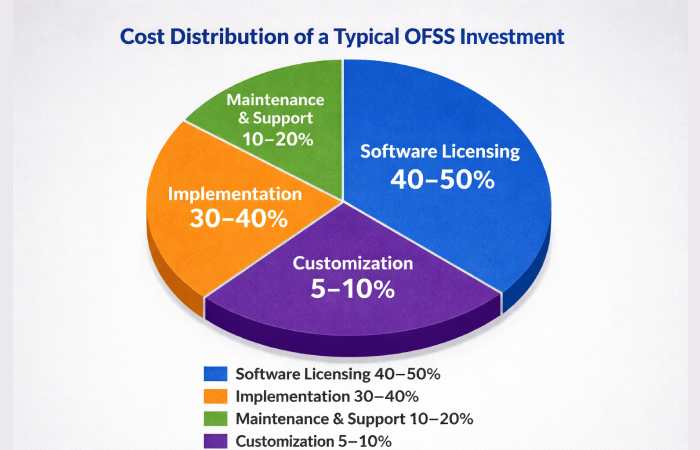
A typical OFSS investment is distributed as follows:
- Software Licensing: 40–50%
- Implementation: 30–40%
- Maintenance & Support: 10–20%
- Customization: 5–10%
This indicates that implementation is often as significant as the software itself.
Key Features of Oracle Financial Services Software
- Scalability
- Supports large-scale banking operations
- Handles high transaction volumes
- Suitable for multinational institutions
- API-Driven Architecture
- Enables integration with third-party services
- Supports open banking initiatives
- Enhances flexibility
- Advanced Security
- Data encryption
- Fraud detection systems
- Regulatory compliance frameworks
- AI and Automation
- Predictive analytics
- Automated decision-making
- Customer behavior analysis
- Cloud Compatibility
- Supports cloud deployment
- Reduces infrastructure costs
- Improves scalability
Advantages of Using OFSS
Strong Integration
OFSS provides a unified platform, reducing dependency on multiple vendors.
High Reliability
Trusted by major banks globally, ensuring stability and performance.
Comprehensive Functionality
Covers nearly every aspect of financial operations.
Limitations and Challenges
High Initial Investment
The cost can be prohibitive for smaller institutions.
Complex Implementation
Deployment can take months or even years.
Requires Skilled Workforce
Specialized knowledge is needed to operate and maintain systems.
Competitor Analysis
The financial software market includes several strong competitors.
Major Competitors
- Temenos
- Infosys Finacle
- FIS Global
- SAP Banking
- TCS BaNCS
Comparison Table
| Feature | OFSS | Temenos | Finacle | FIS |
| Product Range | Extensive | Moderate | Extensive | Extensive |
| Pricing | High | Medium | Medium | High |
| Cloud Support | Strong | Very Strong | Strong | Moderate |
| Ease of Use | Complex | Moderate | Moderate | Complex |
Market Trends in Financial Software
- Shift to Cloud Banking
Banks are increasingly adopting cloud-based systems to reduce costs and improve scalability.
- Rise of AI in Banking
AI is being used for:
- Fraud detection
- Customer insights
- Risk management
- Open Banking Ecosystems
APIs are enabling collaboration between banks and fintech companies.
- Increased Regulatory Pressure
Financial institutions must comply with evolving global regulations. (dcfmodeling)
Use Cases of Oracle Financial Services Software
Retail Banking
- Account management
- Online banking services
- Loan processing
Corporate Banking
- Cash management
- Trade finance
- Treasury operations
Investment Banking
- Risk analysis
- Portfolio management
Insurance Sector
- Policy management
- Claims processing
Who Should Use Oracle Financial Services Software?
Suitable For
- Large banks
- Global financial institutions
- Enterprises with complex financial operations
Not Suitable For
- Small businesses
- Startups with limited budgets
Future Outlook
The future of Oracle Financial Services Software is shaped by:
- Increased adoption of cloud-native platforms
- Expansion of AI capabilities
- Integration with fintech ecosystems
- Focus on real-time data analytics
As financial institutions continue to digitize operations, the demand for comprehensive platforms like OFSS is expected to grow.
Conclusion
Oracle Financial Services Software is still among the most complete and effective solutions in the financial technology industry. It is a choice among the big financial institutions due to its huge product range, developed features, and global presence.
Nevertheless, costs, implementation schedule, and operational needs should be given a serious consideration by organizations before implementing the platform. Although it is the most efficient, it is also costly and needy in terms of investment and skills.
Oracle Financial Services Software will be a powerful and futureproofed solution to institutions that need to pursue modernization of their banking infrastructure, enhanced compliance, and data-driven insights.